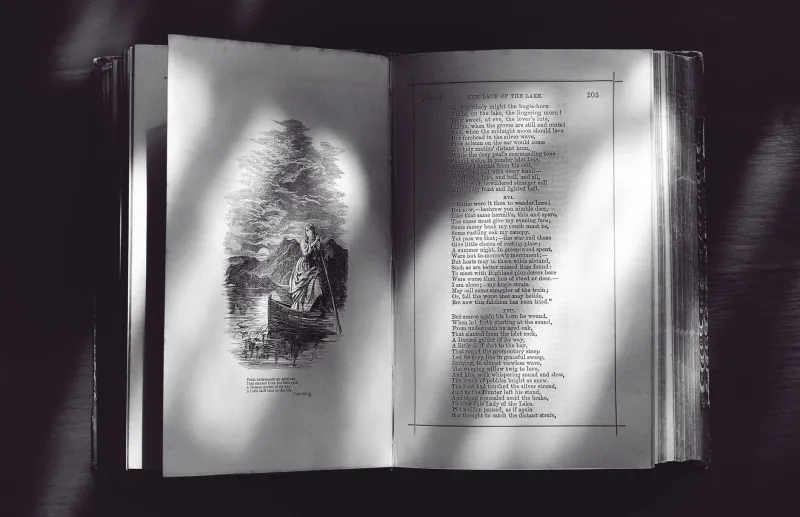
Written in the Margins: How Readers Are Turning Annotated Pages Into Living Poetry

Photo by Photo by Afonso Azevedo Neves on Unsplash on Unsplash
There is a long and venerable history of readers talking back to books. From the penciled exclamations of Victorian scholars to the dog-eared pages of college undergraduates, the impulse to leave a mark on a text is as old as reading itself. Yet something new is taking shape in the margins of American literary culture—something that goes well beyond a scribbled note or an underlined phrase. Poets and readers are increasingly treating the white space surrounding published works as a canvas in its own right, composing micro-poems, lyric fragments, and responsive verse that enter into conversation with the original text. The result is a form at once ancient and radically contemporary, one that is attracting serious attention from literary communities, small presses, and a growing audience on social media.
The Margin as a Creative Threshold
To understand the significance of this trend, it helps to appreciate what a margin actually represents. In the architecture of a printed page, the margin is neither inside the text nor entirely outside it. It is a threshold—a liminal zone where the reader's consciousness meets the author's language. For centuries, scholars called their notes in this space marginalia, a term that carried an implicit suggestion of lesser importance, of commentary subordinate to the main event. What is happening now inverts that hierarchy entirely.
Poets working in this tradition do not merely respond to what they read; they use the existing text as a structural scaffold for entirely new creative work. A line break in the original poem might inspire a counterpoint image in the margin. A metaphor left unresolved by the published author might find its completion—or deliberate contradiction—in a handwritten couplet pressed against the gutter of the page. The annotated text becomes, in effect, a duet.
This practice has a name in some literary circles: responsive marginalia, though practitioners themselves often resist formal labels, preferring to describe the work simply as writing alongside, or writing into, a text. The informality is part of the point. These poems are born from intimacy—from the private, unhurried act of reading—and they carry the warmth of that origin.
Sticky Notes, Stamps, and Digital Hybrids
While the image of a reader writing in the margins of a beloved paperback remains the emotional center of this movement, its material forms are considerably more varied. Many poets work with removable sticky notes, allowing them to annotate library books or borrowed copies without altering the original object. Others use rubber stamps, colored inks, and collage elements, creating visual poems that treat the page as a mixed-media surface. A smaller but growing contingent works digitally, using annotation tools in e-readers or PDF software to layer verse over scanned texts, then sharing screenshots to social media platforms such as Instagram and TikTok.
The social dimension of this practice deserves particular emphasis. What began as an intensely private activity—writing for oneself in the margins of a personal copy—has found a vibrant public life online. Under hashtags and within dedicated communities, readers post photographs of their annotated pages, inviting responses, imitations, and further layers of commentary. A single annotated image can generate dozens of additional poems written in the comments beneath it, creating vertical chains of responsive verse that descend from an original published work through multiple generations of reader-poets. The margin, in this sense, has gone infinite.
A Dialogue Across Time
One of the most compelling aspects of margin poetry is its relationship to literary history. Readers who practice it are, knowingly or not, participating in a tradition that includes some of the most celebrated names in English-language letters. Samuel Taylor Coleridge was a prodigious marginal annotator; his notes in the books of friends and acquaintances were so substantial that they were eventually collected and published as a volume of their own. Herman Melville filled his copy of Shakespeare's plays with observations that scholars now consider essential to understanding his creative development. Walt Whitman annotated voraciously.
What distinguishes the contemporary moment is not the act of annotation itself but the explicit framing of that annotation as original poetry—as a creative contribution worthy of its own audience, its own aesthetic consideration. Contemporary practitioners are not merely noting their reactions; they are crafting. They choose words with the same care a poet brings to any other form. They attend to rhythm, to sound, to the compression that micro-poetry demands. The margin imposes strict formal constraints—there is only so much space—and constraint, as any poet will attest, is often the most reliable engine of creative invention.
What Literary Communities Are Saying
Reception within established literary circles has been, as one might expect, mixed. Some critics and editors view margin poetry with enthusiasm, arguing that it democratizes literary creation by lowering the barrier to entry and inviting readers who might never submit to a journal to begin thinking of themselves as poets. Others express reservations about the blurring of authorship and the potential for confusion between original work and responsive commentary. A handful of small presses have begun publishing curated collections of annotated pages, presenting the combined text-and-margin as a unified artistic object—a development that raises interesting questions about copyright and collaboration.
For their part, the poets engaged in this practice tend to be less concerned with institutional validation than with the quality of the conversation they are having with the texts they love. Many describe the experience as transformative—not just creatively, but as readers. Writing in the margins forces a different quality of attention. It slows the eye. It demands that the reader sit with a single image or phrase long enough to find something to say in return. In this sense, margin poetry may be as much a practice of reading as it is of writing.
Where the Margins Lead
As this form continues to evolve, its implications for American poetry feel genuinely significant. At a moment when the literary landscape is crowded with competing voices and platforms, margin poetry offers something quieter and more intimate—a reminder that the most fundamental act in all of literary culture is the encounter between a single reader and a single text. What the margin poets are discovering is that this encounter need not be passive. The reader, pen in hand, is already halfway to being a poet. The white space is already waiting.
For those who have never tried it, the invitation is simple: find a poem you love, find a pen, and begin. Write what the poem makes you feel, what it leaves unsaid, what it reminds you of, what you wish it had done differently. Write badly at first, if necessary. Write small. The margin will hold whatever you bring to it, and the conversation, once started, has a way of continuing long after the book is closed.