Speaking Through Silence: How Whitespace Has Become One of Poetry's Most Expressive Tools
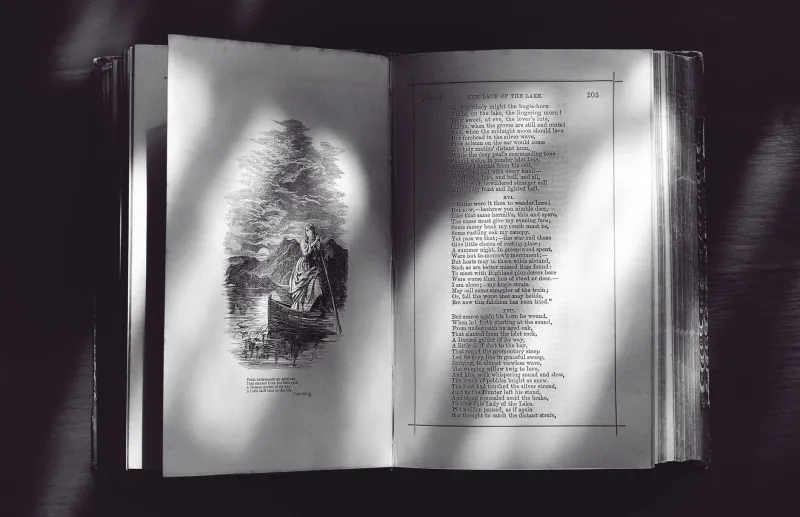
There is a moment, familiar to any devoted reader of poetry, when the eye travels across a line and arrives not at the next word, but at open space. The page breathes. The reader pauses, suspended between what has been said and what has been withheld. That pause is no accident. For a growing number of contemporary American poets, the space between words — the silence that surrounds language — is itself a form of speech.
Whitespace in poetry is hardly a new phenomenon. Since e.e. cummings scattered his letters across the page like scattered thoughts, and since Stéphane Mallarmé conceived of the poem as a visual event, poets have understood that the page is a canvas as much as a vehicle for words. But something distinct is happening in contemporary American poetry: the deliberate, philosophically motivated use of negative space as an active storytelling element — not a stylistic flourish, but a structural argument.
The Page as Stage
To understand why whitespace carries such weight, it helps to think of the page as a stage. Just as a theater director uses silence and stillness to amplify dramatic tension, a poet uses blank lines, wide margins, and fractured syntax to shape how a reader experiences time and emotion. The eye, after all, does not merely scan — it interprets. When a reader encounters a wide expanse of white after a single, devastating line, the brain does not simply move on. It lingers. It asks questions. It fills the void with its own associations.
Ocean Vuong, whose debut collection Night Sky with Exit Wounds and subsequent work Time Is a Mother have earned him a central place in American literary culture, is perhaps the most celebrated contemporary practitioner of spatial composition. Vuong's poems frequently employ dramatic line breaks and isolated fragments that float on the page like objects suspended in water. His use of whitespace is not decorative — it is respiratory. The gaps between his lines function as the silences between musical notes: without them, the melody collapses into noise.
In poems that grapple with grief, displacement, and queer identity, Vuong's negative space carries an emotional weight that words alone could not sustain. When a line ends abruptly and the eye falls into open page, the reader experiences something closer to feeling than reading. The silence becomes a stand-in for the unspeakable — for trauma that resists articulation, for love that exceeds ordinary language.
Fracture as Form
Claudia Rankine approaches whitespace differently, but with equal intentionality. Her landmark work Citizen: An American Lyric is, among many other things, a meditation on the relationship between language and its limits. Rankine's hybrid form — blending prose poetry, essay, and visual art — uses spatial disruption to mirror the psychic disruption of racism in everyday American life. Lines break where they are not expected to. Paragraphs end mid-thought. Images appear without caption.
This fracturing is not a failure of form; it is the form. By refusing to allow language to proceed smoothly and uninterrupted, Rankine replicates on the page the experience of being interrupted — of having one's humanity questioned, one's presence doubted, one's voice cut short. The whitespace in Citizen is the space of the microaggression, the pause before the wrong assumption, the silence that follows an injury too subtle to name aloud.
What both Vuong and Rankine demonstrate is that negative space invites reader participation in a way that densely packed text often cannot. When a poem leaves room — literal, visual room — on the page, the reader is called to inhabit it. The poem becomes collaborative. The reader's imagination, memory, and emotional history rush in to fill the void, making the experience of the poem unique to each individual who encounters it.
The Tradition Behind the Technique
To place this contemporary movement in context, it is worth acknowledging its lineage. William Carlos Williams' imagist precision, with its stripped syntax and visual clarity, laid important groundwork. Gwendolyn Brooks, particularly in her later, more fragmented work, used spatial disruption to reflect the fragmentation of Black urban experience. More recently, the influence of visual art — particularly the minimalism of artists like Agnes Martin — has encouraged poets to think about what the page looks like before a single word appears.
The Language Poets of the 1970s and 1980s pushed this further, insisting that the material form of a text is inseparable from its meaning. Today's poets have inherited this understanding and applied it to urgent contemporary concerns: grief, identity, racial justice, ecological loss, and the fractures of American democracy.
Silence as Invitation
For readers unaccustomed to poetry that asks them to sit with blankness, this approach can initially feel disorienting. We are trained, in an era of information saturation, to move quickly — to fill silence with noise, to scroll past empty spaces. Poetry that insists on stillness runs counter to these habits, and that resistance is itself part of its purpose.
Learning to read whitespace is, in many ways, learning to read differently. It requires slowing down, accepting ambiguity, and trusting that what is absent is as meaningful as what is present. It asks readers to resist the impulse to resolve tension and instead to remain inside it — to let a poem's silence sit in the chest the way music sometimes does.
For poets, the discipline required to leave space is considerable. Every blank line is a decision. Every isolated word is a choice to withhold as much as to offer. In this sense, writing with negative space is an act of profound restraint — and, paradoxically, of profound generosity. The poet who leaves room on the page is leaving room for the reader.
Where Words End, Meaning Begins
At Poetry Angel, we believe that verse is at its most powerful when it reaches beyond the boundaries of language itself. The poets who are reimagining the role of silence and space on the page are not retreating from communication — they are expanding it. They are insisting that poetry can speak in registers that words alone cannot reach.
In the blank space after a devastating line, something happens that is difficult to name but impossible to dismiss. It is, perhaps, the closest a poem can come to the experience it is trying to convey — not a description of loss, but the shape of loss itself, rendered in white.
That is the poetry of silence. And it is asking us to listen more carefully than we ever have before.