Where Strangers Become Witnesses: The Quiet Power of Poetry Open Mics
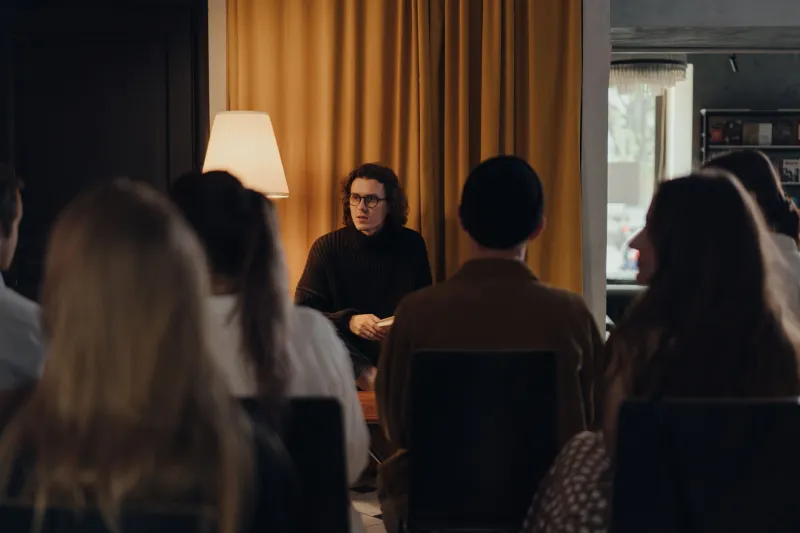
There is a particular silence that settles over a room just before someone steps to a microphone at a poetry open mic. It is not the polished hush of a concert hall or the anticipatory quiet before a keynote address. It is something more fragile — the silence of people who have agreed, without negotiating the terms, to pay attention to one another.
Across the United States, in bookshops and basement bars, community centers and converted warehouses, that silence is repeated hundreds of times each week. And what follows it — the stumbled first line, the steadied breath, the poem that was perhaps finished only hours before — is creating something that no literary journal or podcast can fully replicate: a living community gathered around the spoken word.
The Difference a Room Makes
To understand why open mics occupy a distinct place in American literary culture, it helps to consider what they are not. They are not curated readings where an established poet performs a polished set. They are not slam competitions, where scoring systems and competitive brackets shape the energy of the room. And they are emphatically not recordings, where the speaker and the listener are separated by time, distance, and the mediating presence of a screen.
At an open mic, the poet and the audience breathe the same air. Mistakes are not edited out. Nerves are visible. A poem about grief lands differently when you can see the person who wrote it swallow hard before the final stanza. That immediacy — that irreducible humanness — is precisely what draws people back week after week.
Organizers of long-running open mics often describe the format as inherently democratic in a way that even the most accessible literary publications cannot be. Anyone who signs the sheet gets three minutes. The first-timer stands at the same microphone as the poet who has been coming for a decade. The playing field is not level in terms of craft or confidence, but it is level in terms of access — and that distinction matters enormously to the communities these events serve.
Vulnerability as Currency
The word that surfaces repeatedly in conversations about open mics — among organizers, regular attendees, and the poets themselves — is vulnerability. It is the operative force of the format, the thing that makes it work and the thing that makes it terrifying.
Publishing a poem involves vulnerability, certainly. But the poet who submits work to a literary magazine does so from a remove. The rejection or acceptance arrives privately. The reader encounters the poem alone, on their own terms, at their own pace. The open mic collapses all of that distance. The response — laughter, snapping fingers, a room-wide exhale, or, most devastating of all, silence — is immediate and unmediated.
What is remarkable is that this exposure, rather than discouraging participation, appears to deepen it. Regular attendees at open mics across the country describe a phenomenon that might be called witnessed vulnerability — the experience of offering something deeply personal to a room of near-strangers and having it received with care. That experience, repeated over weeks and months, builds a quality of trust that is genuinely rare in contemporary social life.
In cities like Chicago, Atlanta, Portland, and Philadelphia, certain open mics have become institutions precisely because they have cultivated that trust deliberately. Hosts set the tone from the first moment — acknowledging the courage it takes to approach the microphone, reminding the room that their attention is itself a form of generosity. The best hosts understand that their primary job is not to introduce poets but to hold the space in which connection becomes possible.
Small Towns, Large Stakes
While much of the national conversation about literary community tends to focus on urban centers, some of the most vital open mic scenes in the country are flourishing in smaller cities and rural communities where alternative gathering spaces are few.
In towns where the nearest independent bookstore may be an hour's drive away and where literary events are scarce, a weekly or monthly open mic can function as the sole venue for serious engagement with the written word. Participants describe these gatherings as serving a purpose that extends well beyond aesthetics — they become spaces where people process loss, celebrate milestones, work through political anger, and simply practice the ancient act of being heard.
The stakes, in these contexts, feel particularly high. When a community has fewer outlets for artistic expression, each open mic carries more weight. The poems brought to these microphones tend to be less self-consciously literary and more urgently personal — which is not a limitation but a different kind of strength.
The Architecture of Belonging
What distinguishes a thriving open mic from a merely functional one is often invisible to a first-time attendee. It lives in the accumulated rituals of the space: the way the host remembers returning poets' names, the unwritten rules about how long applause should last, the habit of gathering afterward at a nearby diner or staying to fold chairs together. These small gestures, repeated over time, constitute what sociologists might call social infrastructure — the connective tissue of genuine community.
Poetry, in this context, is not only the content of the gathering but its mechanism. The act of listening to someone else's poem — really listening, without the option to scroll past or skip ahead — is itself a form of practice. It trains attention. It builds the capacity for empathy. And it reminds participants, in the most direct way possible, that language is not merely a tool for information transfer but a medium for human recognition.
That recognition — the feeling of being seen by a room of people who arrived as strangers — is what keeps poets returning to the microphone long after their initial nervousness has faded. It is also what draws audiences who have no intention of ever performing. They come to witness. And witnessing, it turns out, is its own form of participation.
A Living Literature
There is a tendency, in discussions of poetry's cultural health, to focus on metrics: the number of collections sold, the size of a poet's social media following, the prestige of the journals where work appears. These measures have their uses, but they capture nothing of what happens in a room on a Tuesday night when someone reads a poem they have never shared before and a stranger in the third row closes their eyes to listen more carefully.
Poetry open mics are, in the most literal sense, where words take wing — not as metaphor but as sound, as breath, as the irreplaceable experience of language moving through a shared space. They are not a supplement to the literary world. For many of the people who attend them, they are the literary world: immediate, imperfect, and alive.
The communities they build are not incidental to the poems. They are, in many ways, the point.