Sound and Sense: How Hearing Poetry Aloud Unlocks What the Page Cannot
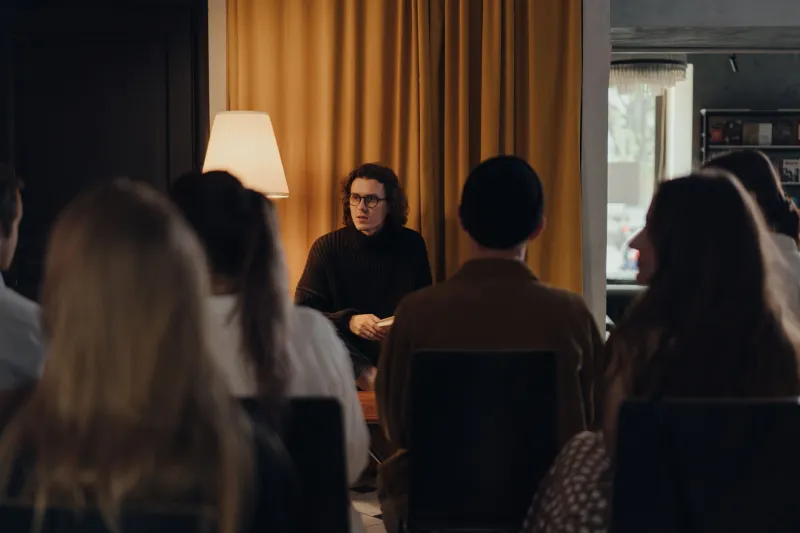
There is a moment, familiar to anyone who has attended a live poetry reading, when a line that seemed merely competent on the page suddenly becomes something else entirely. The poet's breath between stanzas, the slight elongation of a vowel, the barely perceptible pause before a devastating final word—these are elements no font, no line break, no amount of careful typesetting can fully reproduce. Poetry, at its deepest roots, was never meant to be a silent art.
Across the United States, a growing conversation among poets, scholars, and devoted readers is returning this truth to the center of literary culture. Audio poetry—whether encountered through streaming audiobooks, dedicated podcast channels, short-form recitations on social platforms, or the enduring tradition of the live reading—is not simply a convenient alternative to the printed page. It is, many argue, a fundamentally different experience, one that activates different faculties, produces different emotions, and reveals dimensions of a poem that silent reading leaves dormant.
The Ancient Compact Between Voice and Verse
Long before Gutenberg, before manuscripts, before the clay tablet, poetry lived in the mouth and the ear. The oral traditions of Indigenous American peoples, the bardic recitations of early European settlers, the call-and-response structures embedded in African American spiritual and blues forms—all of these remind us that verse was first a spoken contract between a human voice and a gathered community.
Contemporary poets are acutely aware of this inheritance. Poet and professor Camille Dungy, whose work draws on ecological and ancestral themes, has spoken in various public forums about how she composes with sound as a primary consideration, often reading drafts aloud to test whether the rhythm holds before she considers the poem finished. For Dungy and many of her peers, the voice is not a secondary delivery mechanism for a text-based artifact. It is the original instrument for which the poem was written.
This perspective has gained renewed urgency as audio formats have proliferated. The Poetry Foundation's podcast, Poetry Off the Shelf, has introduced millions of American listeners to both canonical and emerging voices. Platforms such as Spotify now host curated poetry playlists and spoken-word albums. On TikTok, a community of creators—operating under tags like #poetryreading and #spokenword—has amassed followings in the hundreds of thousands by reciting original and classic poems directly to the camera, their faces and voices becoming inseparable from the words they deliver.
What Neuroscience Reveals About Listening to Verse
The difference between reading a poem silently and hearing it spoken is not merely aesthetic—it is neurological. Research in cognitive science and psycholinguistics suggests that auditory processing of language engages emotional centers of the brain more directly than visual processing alone. When we hear a human voice, our mirror neuron systems activate, encouraging a form of embodied empathy. We do not simply understand the words; we begin, in a subtle physiological sense, to inhabit them.
Studies examining how the brain processes music and speech in tandem have found that the prosodic elements of spoken poetry—its pitch variation, tempo, and rhythmic patterning—activate auditory cortex regions associated with music perception. In other words, a well-delivered poem can function neurologically in ways that approximate a musical experience, triggering emotional responses that pure semantic comprehension does not reliably produce.
This may explain why so many readers report that a poem they found opaque or unmemorable on the page becomes revelatory when heard in a skilled reader's voice. The meter of a Shakespeare sonnet, the incantatory repetitions in Lucille Clifton's work, the syncopated urgency of spoken-word artist Patricia Smith—these qualities are present as notation on the page, but they are realized only in sound.
How Oral Delivery Reshapes Interpretation
Beyond neuroscience, there is the interpretive dimension to consider. When a poet or a skilled reader performs a poem, they make choices—about pacing, emphasis, tone, and silence—that constitute a form of literary interpretation as rigorous as any scholarly annotation. Two different readers can deliver the same poem and produce what amount to two distinct works of art.
Consider Robert Frost's "The Road Not Taken," a poem so frequently misread as a celebration of bold individualism that Frost himself grew weary of correcting the record. Heard in recordings of Frost's own voice, with his dry, almost sardonic delivery, the poem's irony becomes audible in a way that many silent readers simply miss. The voice, in this sense, is a corrective—a guide through the poem's tonal complexities that punctuation and line breaks cannot fully supply.
This is why many contemporary poets invest considerable thought in how their work sounds in performance, and why an increasing number of collections are now accompanied by author-recorded audio editions. Publishers including Penguin Random House and Graywolf Press have expanded their audio poetry offerings significantly in recent years, recognizing that a substantial portion of their audience encounters verse primarily through their ears.
Discovering Audio Poetry: A Listener's Guide
For readers who wish to deepen their engagement with poetry through listening, the landscape of available resources has never been richer.
Podcasts and Streaming: VS, produced by the Poetry Foundation, pairs poets in conversation around a shared theme, while The Slowdown features former U.S. Poet Laureate Tracy K. Smith offering brief daily readings with personal reflections—a format ideally suited to a morning commute or a quiet evening.
Library and Archive Resources: The Library of Congress maintains an extensive archive of recorded poetry, including historic readings by figures such as Walt Whitman (via early cylinder recordings) through to contemporary voices. Many public libraries provide free access to Audible and similar platforms through services like Libby, making audio poetry collections available at no cost.
Social and Short-Form Platforms: For those open to discovering emerging voices, TikTok and Instagram Reels have become unexpectedly vital spaces for spoken poetry. Creators such as Rudy Francisco and Button Poetry's roster of performers have built substantial audiences by reciting work with an intimacy that larger venues cannot replicate.
Live Readings: Perhaps the most irreplaceable audio experience remains the live reading. Organizations such as the Academy of American Poets maintain a national events calendar, and most major American cities host regular reading series at independent bookstores, universities, and cultural centers.
The Voice as a Form of Trust
There is something quietly profound about the act of listening to a poem. It requires a kind of surrender that silent reading does not—a willingness to receive language at another person's pace, in another person's rhythm, without the ability to skim ahead or linger indefinitely on a single stanza. In this way, audio poetry asks something of its audience that feels almost old-fashioned in the current media environment: it asks for sustained, unhurried attention.
And in return, it offers something the page, for all its permanence and portability, cannot quite provide. It offers the poem as a living act—breath-borne, time-bound, and irreversibly human. Where words take wing, it is often a voice that first lifts them from the ground.